Thursday, November 10, 2022

The Rockies by Rail

 This post is by Sue Tindell.


    One of the more enjoyable trips I've taken was back in the fall of 2015, when my husband and I flew to Vancouver, B.C., and boarded the Rocky Mountaineer train for a trip through the Canadian Rockies. We overnighted in Kamloops and ended our two-day excursion in Banff, Alberta, flying home from Calgary. The scenery was spectacular, and the Rocky Mountaineer lived up to its reputation as a first-class travel option.

    So, when RM announced it was opening a US-based line in our Rockies, I was seriously interested. This past September, Dave and I flew to Utah to begin our ride on the rails!

Jezabel, my cat, didn't want Mommy to leave. Or,
at least she expected to come along.

September 15-16 -- Minneapolis to Moab

    The first leg, as usual, was by car from our Northwest Wisconsin home to Minneapolis. With an early flight on the morning of Friday the 16th, we got a hotel near the airport for the night before. This has the added advantage of allowing us to leave our car parked there for free. For early-morning flights, this is an option you can't beat, especially if you live a couple hours away, as we do. 

There's not much to do when you're waiting for
your shuttle to the airport at 5:30am.
  

    Our flight to Salt Lake City lifted off the next morning on schedule and after a short layover in SLC, we had the short hop to Moab. It was our first visit to this enchanting town in eastern Utah. Moab is at just over 4,000 feet of altitude and has about 5,300 year-round residents, but it's one of Utah's busiest towns for tourism. The reason: outdoor activities, and lots of them. With several national and state parks within a few miles, Moab has tons of things to do, if you like hiking, biking and taking in magnificent desert vistas. 

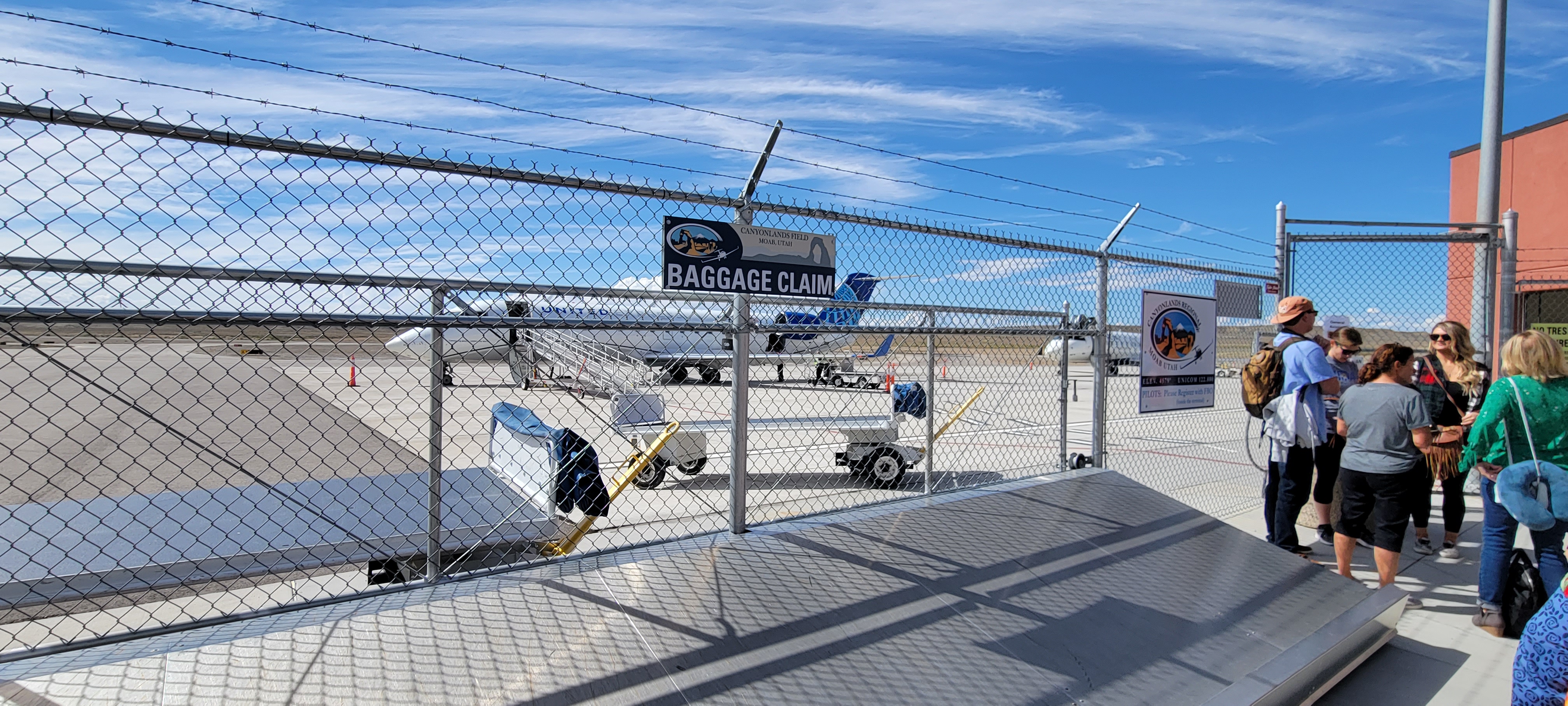
    This was the first airport I'd ever seen with outdoor baggage claim! It also had only a handful of vehicles available at its rental car desk, but one was reserved for us, and off we went for the 16-mile trip to town.


    We'd always heard that the red-rock scenery of Utah was spectacular, and we were immediately convinced as we drove to Moab. Checking into our hotel on the edge of town, we did a little exploring before settling in. We would have two full days to explore this beautiful part of Utah before boarding the train, and we didn't want to waste a minute!


September 17 -- Hiking the Grandstaff, viewing the Arches

    There are so many hiking trails around Moab that we couldn't really go wrong, so we chose one whose trailhead was relatively close to our hotel. The Grandstaff Trail follows a stream deep into the rocky escarpments to a box canyon. We'd heard that a severe rainstorm a month earlier had caused some rather severe flooding on the Colorado River, which flows past Moab, and the streams that flow into it, and indeed there was a sign attached to the trail map warning that the trail might not be all there. The sign was right.


The devastation from the flood was everywhere, often
wiping out the trail. 

We had to cross the stream many times. This
was probably the easiest one. 

Well into the canyon,
we were still in good shape.

The stream had receded back to
its normal channel, but was 
still pretty swift, if not deep.

The end of the trail was in a large cavern hollowed out of
the rock, topped by a huge arch. The stream entered the cavern
from a hole in the wall at the rear. Here's a link to a video
we shot in the cavern: At the end of the trail.


    We hadn't brought our walking sticks along from home, but quickly found a pair from the debris of the flood that fit the bill. It took us two hours to get to the end, and another two to return to the trailhead. On the way out, we encountered several hikers who apparently hadn't read the sign about the washout, because they didn't look prepared. It was a tough go, but well worth the effort! 

    Getting back to our vehicle, we were pretty tired from a morning of rough hiking, but we wanted to drive through Arches National Park before returning to the hotel. The park is big, over 119 square miles, and home to a spectacular collection of natural rock arches, over 2,000 of them. It's very popular, and the line of cars waiting to enter the park can get long. Fortunately, we didn't have to wait too long in line and proceeded into the park, up a winding switchback two-lane road from the park entrance on the valley floor. 


    It had been a long but exhilarating day, and we returned to our hotel satisfied but tired and a little on the dirty side. But thankfully, the hotel had a very nice outdoor pool, so after a refreshing dip we got dressed and headed downtown to look around and have dinner. We quickly discovered Moab has no shortage of souvenir shops and also plenty of nice restaurants. We capped our day with a fine meal, a stop at a local pub to hear some music, and then we returned to the hotel, looking forward to our next day, which would feature a bike ride on one of Moab's many bicycle trails.


September 18 -- Biking north of Moab

    Dave and I enjoy biking along the back roads near our home in the country, and we were looking forward to seeing the great scenery of Utah on two wheels. We'd reserved two bikes from Poison Spider Bicycles, where the staff was very efficient and succeeded not only in renting us bikes and helmets but selling us new pairs of biking gloves. We had decided to ride the trail that actually began right in town and headed north, past our hotel. 

    Once we got past the entrance to the Arches National Park, about four miles outside of town, we got off the paved path and started exploring one of the myriad loops. Fortunately, they were all well-marked with map signs at each trailhead. Our off-road experience back home was pretty limited, so we decided to stick to the easier trails. A couple of excursions onto more difficult terrain quickly resulted in some spills, so we didn't test our limits too much. We got back onto the paved trail and followed it out to the end, then back to town. All told, we covered about 25 miles.


    Dave shot a short video while we were riding: Riding near Moab.

    It had been a fine ride, and we returned to our hotel for another dip in the pool before heading back downtown for dinner. Tonight we would have pizza at Zax Restaurant, which we were told had been founded several years earlier by a couple of University of Colorado football players who had come to Moab and decided to stick around and start a restaurant. 

    Moab had certainly turned out to be a fascinating, exhilarating place, and we'd hardly scratched the surface of its trails and parks. Another visit is definitely on our bucket list. But for now, we would be ready to say goodbye, because the next morning we would be boarding the train!


September 19 -- All aboard the Rocky Mountaineer, to Colorado!

    Monday morning finally arrived, the morning we'd been waiting for: boarding the Rocky Mountaineer train. We gathered at the Moab Tourism Center and registered, then boarded a bus for the short trip about 15 miles north of town to the waiting train. In Canada, we'd experienced RM's deluxe Gold Leaf service, with double-decker cars that had a dining room in the lower level. Not here, though; we'd have the next level of service, Silver Leaf, because American rail tunnels are too small to accommodate Gold Leaf cars. But that was all right, because our car was spacious and relaxing, and the service was first-rate. It didn't take us long to settle in and begin our journey east to Colorado.


    You don't ride the Mountaineer for speed. We would be chugging along at about 35mph, perhaps a little slower as we wound our way along the Colorado River through the mountains. The large windows provided excellent views of the scenery, and we could spend time in the small open observation areas in between the cars. All in all, an excellent and relaxing way to travel!


The "ghost town" of Cisco, Utah, which has one or two
permanent residents. 


Along the Colorado, we often saw people camping, swimming
and fishing. They all waved, and some gave us the moon!


    It was early evening when we pulled into Glenwood Springs, a city of about 10,000 in western Colorado. Glenwood Springs has been known for its therapeutic hot springs for more than a century, but we wouldn't have time to visit them on this trip. Too bad, a dip would've felt nice! But a day on the Rocky Mountaineer is certainly not like a day on a bus or a long airplane flight. We'd enjoyed good food, excellent service and good conversation with some of our fellow travelers. We checked into the Hotel Denver for a good night's sleep, looking forward to tomorrow's run to Denver. I loved the hotel and its vintage decor.


September 20 -- Glenwood Springs to Denver

    We rose early enough to get some chai tea at a coffeeshop and explore a little bit of Glenwood Springs. Dave wanted to see the Hotel Colorado, just across the river, but an easy walk across a pedestrian bridge. His favorite president, Theodore Roosevelt, had stayed there for a few weeks in the summer of 1905. Along the way we got to see one of the town's famous hot springs.

Downtown Glenwood Springs, a place I definitely want to
visit again!

The city's famous hot springs swimming pool. There are
several resorts in the area that incorporate the hot springs into
their property, and they're as popular today as they were
in the 19th century.

The beautiful grounds of the Hotel Colorado, built in 1893.

TR actually ran the country from here
during his several visits for hunting
and swimming. 

I loved the vintage furnishings! They brought out 
my inner Audrey Hepburn!

Getting ready to board, we were
greeted by our train manager!


All aboard for Day 2!


    Back on board, everybody was in a good mood. The mountain air had truly been invigorating, and we were all looking forward to another fine day on the rails. The weather had been spectacular and would stay that way all the way to Denver.
  
    The scenery had started to change when we entered Colorado, becoming more mountainous. The river itself became swifter, with more rapids, but there were many signs of civilization along the way: the occasional riverside home, canoeists and rafters, fishing boats, and people fishing along the bank and picnicking. 


    After lunch, our conductor took some of us on a tour of the club cars, which weren't in much use during this trip, but clearly they offered RM passengers an increased level of comfort and relaxation.


    After lunch, we started approaching the eastern slopes of the mountains, with Denver in the distance. 


    The train arrived in Denver around 3pm, and within a couple hours we'd disembarked, said goodbye to our new friends and to our car's excellent staff, and made our way to our hotel near the airport. It was the end of a scintillating two-day trip, and we knew we'd have to come back someday soon. The train and its crew would be turning around and making a run back to Moab, starting tomorrow, with about 300 passengers on this trip, about double what we'd had on ours. 

    The crowded city and heavy traffic took a little getting used to, after our two days exploring the red rocks around Moab and then riding the train through the mountains. We were already thinking of how we could organize a group tour to Moab and the RM run to Denver next year!


September 21 -- Denver to Minneapolis and home

    The jarring difference between train travel and air travel quickly became apparent to us this morning, when we were shuttled to the airport and waited to board our flight to Minneapolis. The crowds, the lines at security, the mediocre food...well, we quickly realized how superior the train had been. So what if it only went 35mph? We were in no hurry!


    The flight was uneventful, if far too crowded for us, and we drove home without incident. It was hard to believe we'd been on the train just the day before, but just like our first trip on the Rocky Mountaineer, our second was everything they'd said it would be, and more!


Thursday, November 3, 2022

Cruising the Rhine, behind a mask.

 This guest post is by Dave Tindell.


    One of the more memorable vacations Sue and I have taken was a cruise on the Rhine through the heart of Europe in 2006. So, when she told me that we had an opportunity to sail it again, this time on a new ship from AmaWaterways, she didn't have to ask me twice.


Wednesday-Thursday, November 24-25, 2021 -- Wisconsin to Switzerland


    The hardest part of any trip is often getting to where you want to go. For us, it was our standard two-hour drive to the Minneapolis airport, then a cross-the-pond flight to Schiphol Airport in Amsterdam, Netherlands. We had a short layover here before a much shorter flight to Basel, Switzerland, arriving about 6:40am local time on Thursday, which was Thanksgiving Day back home. 


    With COVID fears still gripping the transportation industry, not to mention much of America and, apparently, Europe, we had to stay masked throughout the entire trip. Not exactly the most comfortable way to travel, but we made it. Arriving in Basel, we were shuttled from the airport to the AmaSiena, a year-old ship with a passenger capacity of 158. We would be sailing with about half that number, most of us from the States. It would be our first cruise aboard AmaWaterways, and we were in for a treat. 


After some 20 hours of travel, we
were just a little tuckered out 
when we came aboard.


    But after checking into our very nice cabin and getting something to eat, we were refreshed enough to begin our exploration of Basel, a city we'd visited briefly on our previous cruise. Rhine cruises generally run from Amsterdam to Basel or the other way; travel upriver on the Rhine from here can be difficult, except for smaller craft. 

    Once we got into the city, it was fun to see the holiday decorations and the open-air market, the first Christmas market we would see in Europe. We'd previously purchased apps from the Swiss government into which we could upload our medical information, such as copies of our COVID immunization records, and sure enough, we had to present them to police at the gates, and remain masked at all times, even though we were outdoors. This would be our first encounter with Europe's increasingly-severe restrictions, but definitely not the last. 


Just before entering the market and masking up.

The streets of Basel were busy,
and Christmas decorations were going up.

The statue is of the Roman officer Lucius
Munatius Plancus, who helped Julius Caesar
found the nearby Roman city of Augusta Raurica
in 44BC. It was the first Roman bastion
on the Rhine. 


     After our exploration of Basel, we returned to the boat and prepared to set sail. The Christmas market had been wonderful, although we didn't buy anything, and we were hopeful that the markets to come along the river would be even better. We capped our day with a delightful Thanksgiving turkey dinner, our first sample of the great food that would quickly become a highlight of our AmaWaterways cruise. Sue took the opportunity to take some photos of the Christmas decorations we'd discovered in our cabin and around the boat.


Friday, November 26 --  Riquewihr, France

    Good weather greeted us for our first stop on the Rhine, the Alsace region of France. This is a picturesque province that has been traded back and forth, usually violently, between France and Germany for centuries, but since World War II it has been solidly French. Our destination was the town of Riquewihr. One of the few Alsatian towns not to sustain war damage, Riquewihr is known for its charming medieval architecture and its wines. We found out that the village's Christmas market would not open till the next day, but we were able to sample some mulled wine at the shop of a gentleman who said he grew up in Thunder Bay, Ontario, not too far from Wisconsin!


    We had a great day in Riquewihr, and even scored some new French hats at a Stetson store!


Saturday, November 27 -- Strasbourg

    The good weather we'd enjoyed in Riquewihr deserted us by the time we came ashore in Strasbourg. It was cold, about 34 degrees F (about 1 above zero C over here) with rain and wind. Our walking tour of the city was a bust, not even worth photographing. The original itinerary called for a short bus ride to Heidelberg, the German city where I was born, and we were looking forward to that as we planned the cruise, but now the passengers were informed that not only did Heidelberg require the usual vaccination certificates, but a negative COVID test taken within 24 hours of entering the city. And, we were told, time within the Christmas markets would be limited to perhaps 30 minutes. 

    Needless to say, the Heidelberg outing didn't have many takers. Sue and I had visited the city on our first Rhine cruise in 2006, but we decided to skip it this time, under the circumstances. A few people went, and when they returned to the boat their reviews of the excursion were decidedly negative. There was a rather ominous feeling among the passengers about what was going on. We were all aware of the news reports coming out of South Africa a week or two earlier about a new variant of the virus making its way to Europe, and the governments here seemed to be proactive to the extreme. 

    Ama did what it could, bringing a musical troupe on board for an evening concert, which was well-received: French musical magic. After the show we retired to our cabin, hoping that the next day, on the German side of the Rhine in Speyer, would be better.


Sunday, November 28 -- Speyer and Rudesheim

   Speyer is one of the oldest cities in Germany, tracing its founding to a Roman military camp in 10 BC. Underneath the high altar of the cathedral are the remains of eight Holy Roman Emperors and German kings. 

      We came ashore under reasonable weather and took part in a walking tour of the town, informative and picturesque, as these always are, but the Christmas market was a bit of a bust, with most vendors having chosen not to challenge the increasingly draconian German restrictions.


    Back aboard the AmaSiena, we set sail for the town of Rudesheim, where we would sample its famous coffee, and after an overnight visit, hike the hills above the river. Fortunately, the boat crew came through with yet another fabulous meal, highlighted by a dessert of genuine German apfelstrudel!


Monday, November 29 -- Rudesheim, the Rhine Gorge and Lahnstein Castle

    We had a good-weather morning awaiting us as we came ashore once again in Rudesheim, which is at the upriver entrance to the famous Rhine Gorge. A six-mile hike through the vineyard above the town was a great way to get some exercise and enjoy the scenery.


Ehrenfels Castle, built in the early 13th
century, was damaged in the Thirty Years' War
and finally finished off by the French in 1689.


The Niederwald Monument was built to celebrate
the unification of Germany. Kaiser Wilhelm I,
fresh off his defeat of France in the Franco-Prussian
War, laid the cornerstone in 1871. 

Across the river, the city of Bingen. The river
that bisects the city is the Nahe. 


    Refreshed by the hike, we came back on board as the boat prepared to sail down the Rhine Gorge. Officially known as the Upper Middle Rhine Valley, this is a 40-mile-long stretch of the Rhine between Rudesheim and Koblenz that is home to numerous fairy-tale villages and imposing castles, about 40 of them, many still showing damage from the Thirty Years' War (1618-48). It's one of the biggest attractions for a Rhine cruise, and it didn't disappoint.


    One of the most famous sights in the Gorge is the Lorelei, a 433-foot-tall slate rock on the right bank. The heavy currents, combined with a small waterfall, created a murmuring sound that entranced sailors from Roman times to today. The rock actually produces a faint echo. It's inspired artists, songwriters and musicians for centuries. 


    It was a delightful voyage, but the day wasn't done yet. After dinner we came ashore and trekked to Lahneck Castle, above the riverside town of Lahnstein. Built in the early 13th century, the castle was home to many significant battles and events over the centuries. In 1312, legend has it that the last surviving Knights Templar, rejecting an order by Pope Clement V to disband, made their last stand in the castle against the forces of the Archbishop of Mainz. More than 500 years later, a 17-year-old English girl, Idilia Dubb, was visiting the castle with her family in 1851. Exploring the high tower alone, the wooden floor collapsed under her and she couldn't escape. Her family couldn't hear her cries because the tower was surrounded by an insurmountable wall nearly 10 feet high. Her body wasn't discovered until 1860. The castle was purchased in 1907 by a German admiral and his family has owned it ever since. 
    Our visit was a spooky one, even without the stories about the Knights and the girl. 


    It had been a long day but a very good one, and we retired on board, looking forward to our visit the next day to the city of Cologne. 


Sunday, November 30 -- Cologne

    More dreary weather greeted us this morning in Cologne. The guide for our walking tour was a Boston native who'd moved here to be with his German girlfriend, and he was entertaining as well as informative. Our tour ended with the massive Cologne Cathedral, which was begun in 1248 but not finished until 1880. It is the tallest twin-spired church in the world at 515 feet, and is Germany's most popular landmark, averaging 20,000 visitors a day.

Despite the dreary weather and a citywide requirement
to wear masks in public, even outside, the streets
of Cologne were busy.


The Ostermann Monument, depicting characters
from the lyrics of Cologne songwriter
Willi Ostermann.

Behind Great St. Martin Church are the statues of
Tunnes and Schal, representing the two "halves" of 
the city: short, working-class Tunnes, from the east bank
of the Rhine, and tall, elegant Schal from the west. Visitors rub 
their noses for luck. 

Cologne was a Roman outpost two millenia ago,
and this road once knew the tread of Caesar's soldiers.


The St. Agilulfus Altar, one of many
inside the Cathedral.


The stained-glass windows are some of
the Cathedral's most outstanding features.
Many were removed during the war to
prevent damage during the heavy bombing
of the city.


The Crucifix of Bishop Gero, from
the 10th century; it is one of the 
largest crucifixes in the world.

The most famous object in the Cathedral:
the Shrine of the Three Kings, said to
contain the remains of the three wise men
who attended the baby Jesus. The shrine was
opened in 1864 and contained the bones
of three adults, but their provenance couldn't
be established with the technology of the time.

Tomb of Archbishop Walram of Juelich, in the
Chapel of St. Michael, one of 27 crypts in the
Cathedral.  


After the Cathedral, we walked back to the boat
through the three Christmas markets. Despite warnings
from our guide that we should be prepared to display
our medical credentials on our phones--the modern 
version of the classic "Show me your papers, please"--
we didn't see any police or other officials, as we had
in Basel.

The only time either of us had to show
our credentials was when I stopped to 
buy a bratwurst. It cost 4 1/2 euros
and wasn't as good as a brat from
Louie's Finer Meats back home. 


It cost half a euro to use the public
restroom in the nearby train station.


    It had been a long day, and the Christmas markets, while the most active we'd yet seen, didn't have anything that jumped out at us and said, "Buy me!" (Or, in German, "Kauf mich!") Back aboard the boat, we joined our fellow passengers and crew in receiving COVID tests from German doctors and nurses. Everybody was negative. 
    After another fine dinner, we settled in for the long haul to Amsterdam. We would arrive the next midday, and would be flying home the day after. The weather was again expected to be foul, and the combination of the dreary skies, rain and relentless restrictions was beginning to wear on the passengers. There was much talk of how anxious people were to get back to the States. But the best, in some ways, was yet to come.


Monday, December 1 -- Amsterdam

    The scenery along the Rhine as it flows into Holland isn't much to speak of, as the country is almost flat as a pancake. Indeed, the highest point in the country, the Vaalserberg in the extreme southeast, is only a little over 1,000 feet high, less than the higher hills in Wisconsin, which is not exactly mountainous. After entering the Netherlands, the Rhine splits into several branches. We followed the Waal to a canal past Utrecht to Amsterdam, arriving around noon. 
      Although the weather was once again cruddy, we joined a walking tour of the old section of the city. Somewhat to our disappointment, the infamous De Wallen, the red light district, was shut down thanks to the restrictions imposed by the Dutch government. In fact, we were told, Amsterdam had just initiated a 5pm curfew. No problem, though; we would be back on board by 4. 

The Maritime Museum. The Dutch have been
notable seafarers for centuries. 

Sue bundled up, but it was still chilly.

Examples of Amsterdam's quaint
architecture.

Amsterdam has more than 62 miles of canals,
some 90 islands and 1,500 bridges.

Marijuana is legal here, but they don't want
anybody toking near schoolyards. 

Some of the marijuana-based products 
widely available in stores. We didn't get any.


    The highlight of the tour was a stop at a coffee shop for hot chocolate, aged cheeses and a "bitter ball," which was a soft, deep-fried meatball. Back on board, we showered and changed to get ready for our last evening on board. The AmaSiena was bringing a trio of classical musicians aboard from the troupe known as La Strada, and we were really looking forward to it.
    But around 4:45pm, a half-hour before the start of cocktail hour, the boat's cruise director, a young woman from the Transylvania region of Romania, came on the intercom to tell us that due to the city's 5pm curfew, the boat would not be allowed to hold the cocktail hour or the show, and dinner would have to be served in our cabins. We sat there in stunned disbelief. Outside in the corridor came the sound of prowling, cursing passengers. About twenty minutes later, another announcement: the captain, after consultation with AmaWaterways headquarters, had decided to defy the curfew. All curtains in the lounge and the dining room would be closed, the gangplank to the pier would be pulled, guards would be posted, and the cocktail hour and concert were on! Cheers rang throughout the ship.

Our entertainment was a magical hour of music
from La Strada, featuring a Lithuanian violinist,
a Russian guitarist and a Portuguese violinist. You
can here some of it here.

     As we sat in the lounge enjoying a drink and the wonderful music, I couldn't help looking past the musicians to the entry to the lounge amidships. Just beyond that was the entry door to the boat. At any minute, I expected to hear the distinctive up-down wail of sirens, followed by the sound of boots on concrete and then shouts and pounding on the door. It was like being inside a World War II movie.
    But the sirens never wailed, the boat was left alone, and a fine time was had by all. The American passengers were a merry bunch, shaking the captain's hand, giving high-fives to each other. The crew, most of whom were Eastern Europeans, were puzzled by our behavior. Our server, a young Ukrainian woman, asked us, "You Americans, you defy authority?" "When we have to," we said. 
    

Tuesday, December 2 -- Amsterdam to Minneapolis and home

    There was one final example of the madness that COVID had visited upon Europe. After being tested by the Germans in Cologne and found negative, we'd been given certificates and were told that we'd have to present these at customs in Amsterdam in order to leave the country without going into quarantine. But at Schiphol, nobody asked for them. Sue offered hers at the customs desk and the guy just shook his head and waved us through. Likewise at customs in Minneapolis. Nobody cared. 
     Our return flight and drive home were uneventful, and we were left to contemplate our experience in Europe. History will determine whether or not all these COVID restrictions really did any good, but there is no doubt but that they came close to spoiling the cruise for everyone. Certainly the Christmas markets were severely impacted. It wasn't necessarily a hardship to have to wear a mask everywhere, but having to carry credentials at all times when not on board the ship got to be tiresome. You never knew who might ask to see them, and like the movies, we were wary of hearing, "Your papers...are not in order. You must come with us." Americans aren't used to that; it's what people in other countries have to do, where liberty doesn't reign supreme as it does here. 
    But AmaWaterways got high marks from us and our fellow passengers. The food was great, the boat was first-class all the way and so was the service. We will definitely sail with the line again. 
    Having said that, it was oh so good to get home.